
When it's time to choose a stone and masonry contractor, your decision really boils down to one thing: a proven history of incredible craftsmanship. It's not just about laying stones correctly. The best masons, like us here at Tamura Designs, blend technical skill with an artist's eye to create work that's not only durable but genuinely beautiful.
A true professional will always have a portfolio they're proud to show you, fantastic client reviews, and business practices that are completely transparent.
Your Blueprint for Vetting Masonry Professionals
Trying to find a real artisan for your stone or brick project can feel like a huge task. There are so many options out there, but the gap between a "good enough" job and a true masterpiece is massive. It all comes down to the contractor's experience, their dedication to the craft, and the process they follow.
This guide will give you a solid framework for spotting the non-negotiables that separate the premier masons from everyone else. You're not just hiring someone to stack bricks; you're looking for a partner who will bring your vision to life with integrity and skill. Let's get you ready to start your search with confidence.
The Four Pillars of a Great Contractor
To properly vet potential contractors, you need to zero in on four critical areas. Think of these as the foundation for any trustworthy and skilled professional—get these right, and your project is set up for success.
-
Proven Expertise: Don't just take their word for it. A great contractor will have a rich portfolio filled with projects similar to yours. They should be able to walk you through the technical details, from why granite is a great choice for durability to the subtle techniques for laying a perfect travertine patio.
-
Impeccable Reputation: In this business, reputation is everything. Word-of-mouth and online reviews are incredibly powerful tools. Look for detailed testimonials that talk about the contractor’s professionalism, how they handled timelines, and the final quality of their work. To do this right, it helps to understand what a testimonial is and its power in building trust, because authentic feedback is a direct reflection of a contractor's reliability.
-
Transparent Processes: Communication should be crystal clear from the first quote to the final walkthrough. A detailed, itemized estimate is a sure sign of an organized pro who values transparency, rather than someone who hides costs in vague summaries.
-
Commitment to Quality Materials: The best contractors have long-standing relationships with top-notch suppliers. They won't just sell you on something; they'll guide you, explaining the pros and cons of different materials—like sandstone versus slate—for your specific project and local climate.
A contractor's willingness to discuss material science—like why a dense, low-porosity stone is better for freeze-thaw cycles—is a strong indicator of their expertise. It shows they're not just building for today, but for decades to come.
To help you keep track, here's a quick checklist to reference as you meet with potential contractors.
Key Contractor Vetting Checklist
| Vetting Area | What to Look For | Why It Matters |
|---|---|---|
| Portfolio & Experience | A diverse gallery of completed projects similar to yours. | This confirms they have the specific skills and artistic vision your project requires. |
| Client Reviews & References | Detailed, positive testimonials and a list of references you can call. | Honest feedback from past clients is the best predictor of your future experience. |
| Licensing & Insurance | Proof of current general liability insurance and proper local licensing. | This is non-negotiable. It protects you from liability and financial risk. |
| Communication Style | Clear, prompt, and professional communication from the very first contact. | Good communication avoids misunderstandings and keeps the project on track. |
| Detailed Bids | An itemized quote that breaks down costs for labor, materials, and permits. | Vague bids can hide unexpected costs. Transparency builds trust. |
Using this checklist will give you a structured way to compare contractors and ensure you're not missing any critical details.
Recognizing Red Flags Early
As you start having conversations, keep your radar up for warning signs. A contractor who is hard to get ahold of, gives you a fuzzy or suspiciously low bid, or pressures you for a quick decision is probably not the partner you want.
And if they're hesitant to provide references or show you their license and insurance? That's an immediate deal-breaker.
Another subtle but important red flag is a lack of curiosity. The best contractors are collaborators. They ask thoughtful questions about your project, your lifestyle, and what you want the final result to feel like. They aren't just laborers. By keeping these pillars and red flags in mind, you can confidently find a true masonry craftsman for your home.
How to Evaluate Portfolios and Craftsmanship
A contractor’s portfolio is their visual resume, but you have to know how to read between the lines. It’s easy to get wowed by beautiful, sweeping shots of finished patios and grand retaining walls. But the real story of quality isn’t in the wide-angle view; it's tucked away in the details.
When you start flipping through a portfolio, train your eye to look closer. Are the photos high-resolution, letting you zoom in? If all the images are shot from a distance, it might be a subtle sign they don’t want you scrutinizing the handiwork up close.
Look for Signs of Superior Craftsmanship
Great masonry is where art meets engineering. The evidence of a true artisan is in the execution—the kind of precision and consistency that a less-experienced mason simply can’t fake. Knowing what to look for empowers you to spot the difference between average work and truly exceptional skill.
Here are the technical details I always tell clients to examine:
- Clean and Consistent Mortar Joints: Look at the gaps between the stones. They should be uniform in width and depth. There shouldn't be any sloppy mortar smudges on the faces of the stones, and the texture should be smooth, not cracked or lumpy.
- Precise and Intentional Cuts: Pay attention to how stones meet at corners or fit against a straight edge. Are the cuts sharp and snug? Ragged, chipped edges suggest rushed work or a lack of the right tools and patience.
- Harmonious Pattern and Flow: Whether it's a formal pattern or a more organic, random layout, the whole project should feel balanced. A real craftsman doesn't just grab the next stone; they select and place each one to create a visually pleasing rhythm.
A key indicator of a top-tier mason is their ability to handle complex shapes and transitions. Pay close attention to how they manage curves, stairs, and junctions between different materials. This is where true artistry becomes apparent.
Beyond the Photos: Seeing Work in Person
A digital portfolio is a fantastic starting point, but it can't show you the most important thing: how the work holds up over time. The ultimate test of craftsmanship is how it endures real-world exposure to sun, rain, and changing temperatures.
That’s why you absolutely must ask for addresses of completed local projects. A confident contractor will be proud to share a list of two or three jobs that are at least a few years old. When you visit, you aren't just looking at the design—you're investigating its durability.
What to Inspect During a Site Visit
Seeing a project in the flesh gives you insights a photograph never could. You're looking for signs of longevity and proper technique that reveal how the work has settled and weathered.
Here’s a quick checklist for your drive-by inspection:
- Check for Settling or Shifting: Look at a patio or wall from a few different angles. Are the lines still level and straight? Any significant sinking or heaving can point directly to a poorly prepared foundation—a critical shortcut you don't want.
- Inspect for Cracks or Water Damage: Scan the mortar joints for cracks. Also, look for signs of efflorescence—that white, powdery stain on stone—which often indicates moisture getting trapped behind the work due to improper water management.
- Evaluate the Overall Condition: After a few years of Minnesota weather, does the stonework still look solid and appealing? Quality materials and expert installation should age gracefully, developing a beautiful natural patina rather than deteriorating. Many of the best practices that ensure this longevity are also sustainable; you can learn more about them in our guide to eco-friendly landscaping.
Taking these extra steps is what separates a hopeful homeowner from a savvy one. It ensures you’re not just hiring a contractor, but investing in a true craftsman whose work will add value and bring you joy for decades to come.
Checking for Licenses, Insurance, and Credentials
Let's talk about one of the biggest—and most avoidable—mistakes you can make when hiring a stone or masonry contractor: skipping the paperwork. I know, it's not the exciting part of the project, but bringing on a contractor without the right credentials is a massive gamble. You're not just risking a shoddy job; you could be opening yourself up to some serious financial and legal trouble.
Think of it this way: skipping this step is like building a gorgeous stone retaining wall on a foundation of quicksand. It might look solid for a minute, but it's only a matter of time before things go wrong.
A true professional sees their licenses and insurance as a safety net. For you, it’s a non-negotiable shield. When a contractor has taken the time and effort to get properly credentialed, it speaks volumes about their commitment to their craft, their business, and most importantly, their clients. It's a fundamental sign that you're dealing with one of the good ones.
What to Look For: Essential Masonry Credentials
Not all credentials carry the same weight, so you need to know what you’re asking for. Licensing rules can change depending on your state or even your city, but any legitimate contractor should have no problem showing you proof of their status. Some of the best masons also hold certifications from respected industry groups like the Mason Contractors Association of America (MCAA), which shows they're dedicated to a higher standard of work.
When you start this conversation, don't just settle for a license number scribbled on a business card. Ask to see the actual documents. More importantly, know how to check them yourself. Most states have an online database where you can enter a contractor’s license number to see if it's active and in good standing.
The image below gives you a sense of the typical workflow for a masonry project. Each one of these stages demands skill and precision, which is exactly why the person overseeing it all has to be properly qualified and insured.
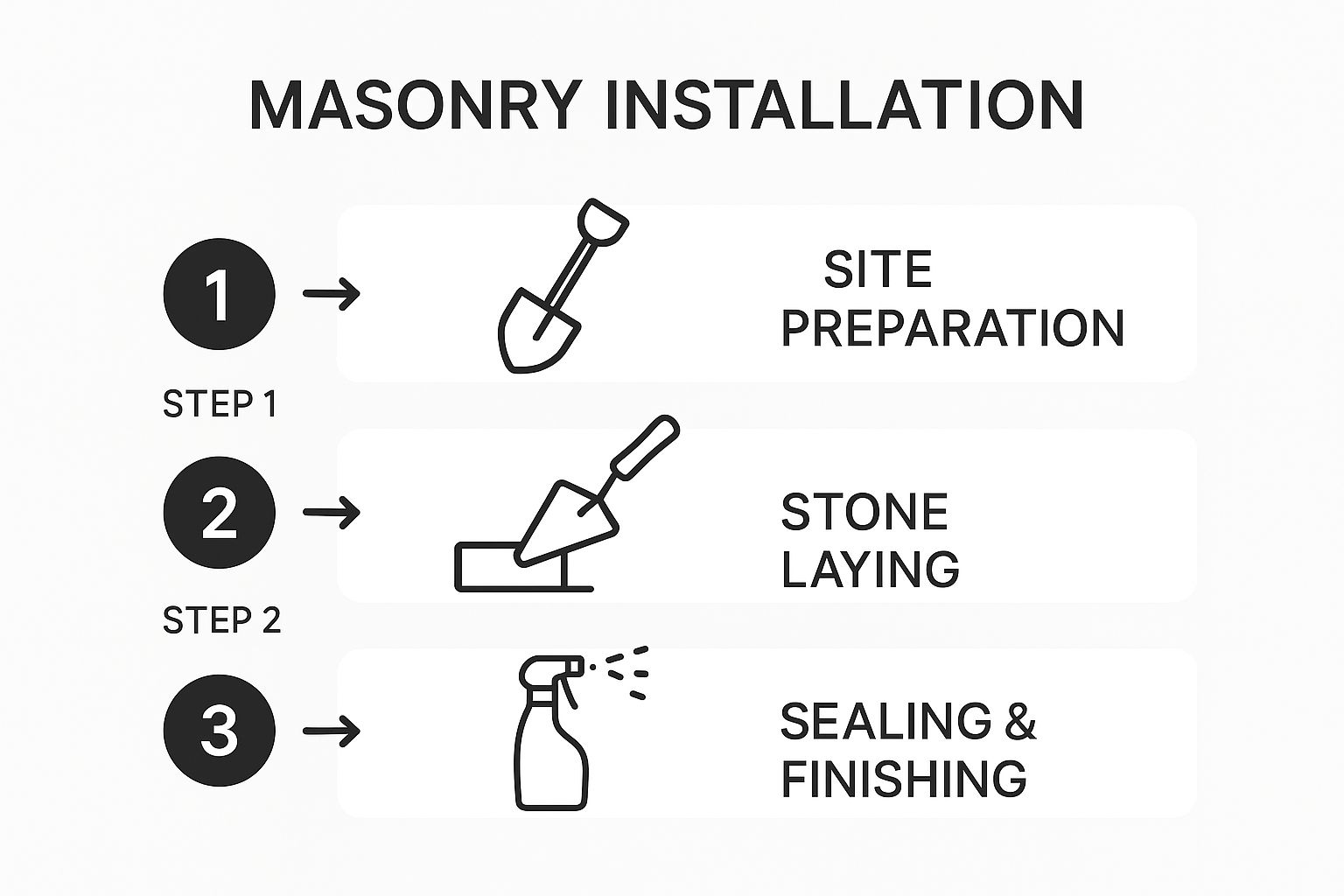
Seeing the skilled labor involved at every point really drives home why you need a vetted professional running the show.
The Two Policies You Absolutely Cannot Ignore
Beyond a business license, there are two types of insurance that are non-negotiable. If a contractor can't show you proof of both, walk away. It's that simple.
-
General Liability Insurance: This is what protects your property. If a crew member accidentally backs a truck into your garage door or drops a stone through your neighbor’s fence, this policy covers the damage. Without it, you could be on the hook for their mistake.
-
Worker's Compensation Insurance: This protects the crew working on your property. If a mason gets hurt on the job, this insurance covers their medical bills and lost pay. If the contractor doesn't have it, you could be held liable as the homeowner. Just imagine getting sued over an injury that happened on your property—it’s a financial nightmare.
Never, ever just take a contractor's word that they're insured. The gold standard is to request a Certificate of Insurance (COI) sent to you directly from their insurance agent. This is the only way to know the policy is real and currently active.
When you get that COI, actually read it. A contractor with at least $1 million in general liability coverage is a good sign—it shows they're a serious business that understands risk. Lower limits might be legal, but they might not be enough to cover a major accident.
Asking for and verifying these documents isn't about mistrust; it’s just being a smart, responsible homeowner. Any true professional will respect your diligence. If a contractor gets defensive or gives you the runaround, that’s all the answer you need.
Protecting your investment starts long before the first stone is laid. It starts with ensuring your project is built on a solid foundation of accountability. To see how these principles come to life, you can check out examples of custom stone and masonry services that are built on this very commitment.
Making the Most of Your Project Consultation

This first meeting is your single most important interview. It's where you move past the polished online portfolios and get a real feel for the person you might be working with for weeks or even months. You're not just assessing their technical skills; you're gauging their communication style, their professionalism, and whether they truly get your vision.
Think of it less as a quote request and more as a two-way conversation. The best contractors are also interviewing you. They’re trying to understand your expectations to see if the project is a good fit for their team and workflow. A great consultation lays the groundwork for a smooth, collaborative, and ultimately successful project.
Look Beyond the Price Tag
Of course, the budget matters. But focusing only on the bottom line is a classic mistake that can blind you to major red flags—or signs of a truly exceptional partner. The goal here is to dig deeper into their process, their problem-solving skills, and their whole approach to the craft.
A great contractor will welcome your questions. It shows them you're an engaged and serious homeowner. On the flip side, if a contractor gets defensive, seems impatient, or brushes off your inquiries, take that as a serious warning. This initial meeting is often the best behavior you'll ever see. If it's poor now, it's not going to get better once they have your deposit.
Key Questions to Guide the Conversation
Don't go into this meeting cold. Arm yourself with a list of thoughtful questions. This not only ensures you get the information you need but also signals that you've done your homework. You want to understand how they work, not just what they'll do.
Here are a few questions I always recommend homeowners ask:
- Project Management: "How will you keep me updated on the project's progress and timeline? Will I have one main point of contact?" This cuts right to their organizational skills.
- Problem-Solving: "Can you tell me about a time a project went off-track—maybe a material delay or an unexpected site issue—and how you handled it?" Their answer reveals everything about their professionalism under pressure.
- The Team: "Will you personally be on-site? If not, who is the crew leader, and what’s their experience? Do you use subcontractors?" You need to know exactly who will be working on your property.
- Site Logistics: "How do you manage site cleanliness and safety at the end of each day? Where will materials and equipment be stored?" This speaks volumes about their respect for your home.
The single most important thing to watch for is how well they listen. Do they interrupt you or let you finish your thoughts? Do they ask clarifying questions? A true partner wants to understand your vision before they start telling you their plan.
Observe Their Professionalism and Approach
Pay attention to the little things. Did they show up on time? Were they prepared with a notebook, measuring tape, or portfolio? These small details are often a window into their overall work ethic.
A top-tier contractor won't just stand there and nod. They’ll walk the property with you, actively listening but also offering their own professional insights. They might spot a potential drainage problem you missed or suggest a type of stone that would better suit your home’s architecture. This collaborative spirit is the hallmark of the best stone and masonry contractors. They’re expert guides, not just order-takers.
The masonry industry is a powerhouse in the construction world, with revenue in the United States projected to hit $40.8 billion by 2025. This isn't surprising, as quality stonework adds timeless value. If you're interested in the market data, you can read more about masonry industry trends on IBISWorld.
Ultimately, you’re looking for a partner. You need someone whose skill with stone is matched by their ability to communicate clearly, manage a project effectively, and treat your home with respect. Trust your gut. If the conversation feels right and their answers build your confidence, you’re on the right path.
You've done the interviews, checked the references, and seen the portfolios. Now comes the moment of truth: looking at the actual contract and estimate.
This isn't just about the price tag. This document is the blueprint for your entire project, the single source of truth that turns conversations and promises into legally binding commitments. It’s what protects you and the contractor.
A flimsy, one-page quote is a massive red flag. I've seen them before, and they almost always lead to trouble. The best pros provide detailed, line-item bids that leave zero room for interpretation. This isn't just a courtesy—it’s the mark of an organized, transparent business that respects your investment.
Vague Quote vs. Detailed Bid: Spotting the Difference
The gap between a vague quote and a detailed bid is huge. One creates risk and confusion; the other builds confidence. Knowing what a proper bid looks like is your best defense against surprise costs and headaches later.
A vague quote might just say, "Stone Patio: $15,000." That tells you next to nothing. What kind of stone? How deep is the base? What about cleanup?
A truly professional bid breaks it all down, and this is what you should demand:
- Labor Costs: Clear costs for labor, often broken down by phase—like demolition, base prep, laying the stone, and final cleanup.
- Material Breakdown: A specific list of every single material. This means the type of stone, the gravel for the base, the specific mortar, and any sealants, all with quantities and price per unit.
- Permit Fees: If permits are needed, their costs should be listed as a separate line item.
- Equipment Rental: Any special equipment needed for the job, like a compactor or stone saw, should have its rental cost included.
This level of detail shows you exactly where your money is going. It also gives you a real, apples-to-apples way to compare bids from different companies.
A truly professional estimate proves the contractor has thought through every single step of your project. It's evidence of their experience and a commitment to honest, clear project management right from the start.
To make sure you don't miss anything, using a contract review checklist can be a lifesaver. It helps you go through every clause systematically so no critical details fall through the cracks.
Key Contract Clauses You Can't Afford to Skim
Once you’ve settled on an estimate, the formal contract will lock in those details. This is the legal document, and it needs to be crystal clear. I always tell my clients to pay extra attention to these specific areas.
Project Timeline
A contract must have a clear start date and an estimated completion date. Sure, weather happens, and unexpected issues can pop up. But having a baseline timeline makes everyone accountable. A solid contract will also specify how any schedule changes will be communicated and documented.
Payment Schedule
Never, ever pay for the entire project upfront. A standard, fair payment schedule usually looks like this:
- An initial deposit (typically 10-30%) to book your spot on their calendar and cover the first material orders.
- Progress payments tied to specific, completed milestones. For example, another payment is made after the foundation and base are installed.
- Final payment is made only after the project is 100% complete, you’ve done a final walkthrough, and you've signed off on the finished work.
Change Order Clause
Projects can evolve. Maybe you decide halfway through that you want to expand the patio or use a different type of stone. A "change order" clause defines the exact process for this. It ensures any changes—along with the new costs and timeline adjustments—are put in writing and signed by both of you before the new work starts. This simple clause prevents scope creep and shocking bills at the end.
Where Are the Materials Coming From?
The beauty and longevity of your project come down to one thing: the quality of the materials. The best masons have long-standing relationships with reputable quarries and suppliers. They can guide you to the perfect stone for your climate and style.
For example, a dense stone like granite is fantastic for areas with harsh freeze-thaw cycles, while something like travertine offers a beautiful, luxurious feel for patios in milder climates. Material selection is also a huge factor in the final price—you can see how it impacts the factors that influence the cost of a retaining wall.
The global demand for top-tier stone is always growing. The natural stone market, which is the lifeblood of this craft, was valued at around $42.04 billion in 2024 and is projected to keep climbing. This shows just how much people value the timeless appeal of quality stone.
Don't be afraid to ask your contractor where they source their materials and why they recommend a specific stone or paver. A true craftsman will be passionate about this. They'll be excited to share their knowledge and help you choose a material that will not only look stunning but will truly stand the test of time.
Alright, you've narrowed down your list of potential masons, checked their portfolios, and verified their credentials. But even with all that done, it's completely normal to have a few last questions nagging at you. This is a big investment in your home, after all, and you want to be sure about every detail.
Think of this as your final Q&A before you commit. We're going to tackle some of the most common things homeowners wonder about right before they hire a pro. Getting these answers will give you the confidence you need to sign on the dotted line with one of the best stone and masonry contractors in your area.
What’s a Realistic Timeline for a Custom Stone Project?
This is easily one of the most frequent questions we hear, and the honest answer is always, "it depends." A simple flagstone walkway might only take a week, but a sophisticated outdoor kitchen with a custom-built fireplace could easily stretch over a month.
The final timeline really hinges on a few key variables:
- Project Complexity: It’s one thing to lay a simple, flat patio. It's another thing entirely to build a multi-level retaining wall that incorporates steps and lighting. The more intricate the design, the longer it will take.
- Material Availability: If you have your heart set on a rare or specialty stone, sourcing it can add weeks to the schedule. On the other hand, common materials like local granite or sandstone are usually ready to go.
- The Weather: Mother Nature always has the final say. Rain, snow, or even extreme heat can bring outdoor work to a standstill. A good contractor always builds some buffer days into their schedule, but you can’t plan for everything.
- Permitting: Should your project require a permit from your local building department, that approval process can take anywhere from a few days to several weeks, depending on how busy they are.
A true professional won't just give you a single completion date. They’ll provide a detailed, phased timeline in their proposal that breaks down the project into milestones for demolition, foundation prep, installation, and final cleanup.
A contractor who just gives you a vague "a few weeks" without walking you through these factors probably hasn't thought through your project completely. The best masons are transparent about what could cause delays and will communicate proactively.
How Should We Handle Creative Differences?
It's your home, but it's their craft. So what happens when your vision doesn't quite match the mason's professional recommendation? This is a critical conversation to have before the work starts, not when you’re halfway through the build.
First, remember why you hired an expert. When a mason suggests using a different joint style or a stronger base material, it's almost always rooted in their deep understanding of structural integrity and long-term durability. For example, they know that using stone dust instead of sand to set flagstones helps prevent washout and keeps ants from moving in, which ensures your patio stays stable for decades.
Aesthetic choices, however, are a bit more subjective. A great contractor will listen to what you're trying to achieve and find a way to merge your desired look with sound building practices. If you feel like your ideas are being shot down without a solid technical reason, that’s a red flag. This should feel like a partnership, not a battle of wills.
What Kind of Maintenance Does New Stonework Require?
One of the best things about natural stone is its incredible toughness. Most quality stonework needs very little attention, but "low maintenance" isn't the same as "no maintenance."
The specific upkeep really depends on the stone and where it’s used:
- Patios and Walkways: These will need an occasional sweep to clear off leaves and debris. If you have a dry-laid patio, you might need to top off the joint material (like stone dust) after the first year or so as things settle.
- Sealing: Some stones, especially more porous ones like limestone or travertine used in an outdoor kitchen, will benefit from being sealed every few years to ward off stains. Denser stones like granite often don't need to be sealed at all.
- Cleaning: For everyday dirt or a bit of algae, a gentle wash with a pH-neutral cleaner is all you need. Stay away from the pressure washer—it can be too aggressive, potentially damaging the stone's surface or blasting out the mortar between joints.
A thoughtful contractor will provide a simple care sheet for the specific materials they installed. It's a small touch, but it’s one of those details that separates the good stone and masonry contractors from the great ones.
How Do I Budget for Custom Work and Potential Overages?
Budgeting for custom masonry requires a little bit of wiggle room. A detailed, line-item proposal is your best starting point for understanding the costs, but sometimes surprises pop up. The most common cause of overages is discovering an issue after the work has already begun—like finding poor soil quality that requires a much deeper foundation than anyone anticipated.
A good rule of thumb is to have a contingency fund of 10-15% of the total project cost set aside. This buffer isn't for adding new features on a whim; it's there to give you peace of mind so that an unexpected problem doesn’t derail the entire project.
The cost of materials themselves is also a huge factor. The global market for masonry supplies—from the stone and brick to the cement and sand—is a massive industry, and its fluctuations directly affect your project's bottom line. For those interested, you can learn more about the global masonry market on MarketResearch.com to see the forces that influence material prices. By planning for both the known costs and the unexpected, you can keep your project on solid financial ground from start to finish.
Ready to transform your outdoor space with award-winning craftsmanship and personalized design? Tamura Designs has over 30 years of experience creating stunning and sustainable landscapes for homeowners across Silicon Valley. Let us bring your vision to life. Visit us online at Tamura Designs to schedule your consultation.
