
Your home's entryway does more than just welcome guests—it sets the entire tone for your property. It's the first impression and the last goodbye. For homeowners in Morgan Hill, a well-thought-out entryway remodel can be a game-changer for curb appeal and daily convenience. But let's be honest, the project's success hinges on finding the right contractor.
This guide is designed to walk you through that process, taking you from the first spark of an idea to a finished entryway you'll love for years to come.
What's Happening with Entryway Remodels?
If you're thinking about upgrading your entrance, you're in good company. An entryway remodel is more than just swapping out a door; it's a smart investment in your home's value and your everyday life. A great design introduces better flow, clever storage, and a boost in security, turning a simple threshold into a truly welcoming part of your home.
This push for smarter, more beautiful homes is happening everywhere. In fact, the global home improvement market was valued at a massive USD 916.07 billion in 2024 and is expected to climb past USD 2.05 trillion by 2037. What’s driving this? More people are living in urban and suburban areas like Morgan Hill, and we're all looking for ways to make our homes more functional and beautiful. It's no surprise that entryways are getting so much attention. You can dig deeper into these trends in this report on home improvement growth.
Set Yourself Up for Success
Before you even think about calling contractors, a little prep work on your end will make a world of difference. A successful remodel starts with a clear vision. You’re not just hiring someone to swing a hammer; you’re inviting a partner into your home to bring that vision to life.
To make sure you've covered all your bases, it's a good idea to use a comprehensive house renovation checklist. It’s a great tool for thinking through all the moving parts, from big design decisions to the small finishing touches that matter.
A great entryway remodel creates a seamless transition between the outside world and the sanctuary of your home. It should reflect your home's character while serving practical needs for storage, durability, and security.
Your job at this stage is to define what a "win" looks like for your specific project. Think through these points as you start sketching out your ideas:
- Function Over Form: How does your family really use this space? Is it a dumping ground for muddy shoes, school bags, or the dog's leash? Plan for that.
- Find Your Style: Are you trying to complement Morgan Hill's classic charm, or do you want to make a bold, modern statement?
- Choose Materials Wisely: Think about wear and tear. Is your front door baked by the sun all afternoon? Does it get hit with wind and rain? Your material choices need to stand up to the job.
Crafting Your Entryway Vision And Budget
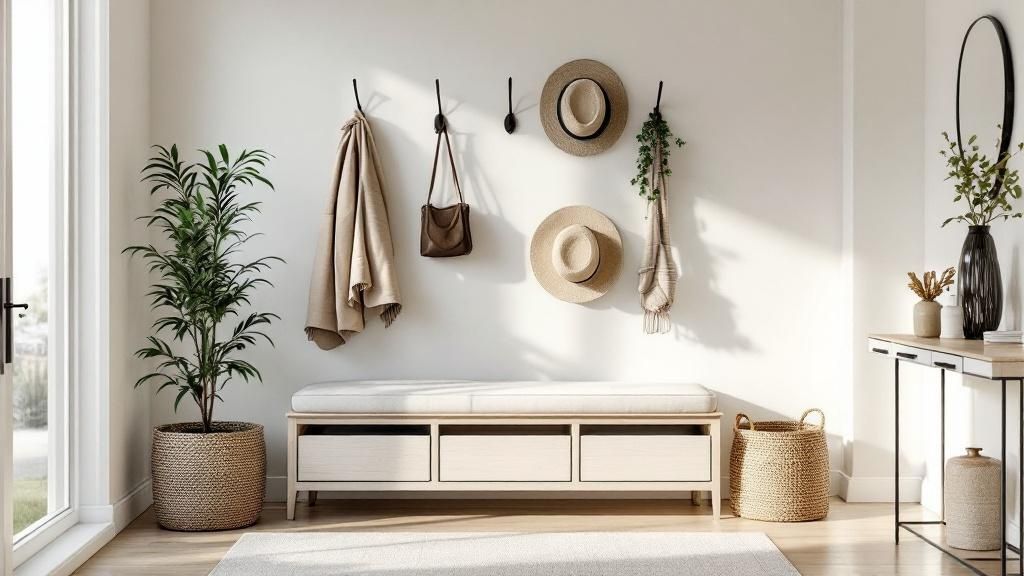
Before you even think about picking up the phone to call a contractor, the real work begins. It happens right at your kitchen table, turning that nagging thought—"we really need to do something about this entryway"—into a clear, tangible plan. This is where you lay the foundation for a smooth and successful remodel.
Start by getting inspired. Take a look around Morgan Hill. Are you drawn to the classic Spanish Colonial Revival homes, or does a more contemporary, sleek aesthetic feel more like you? Hop on Pinterest, save photos, or even just create a folder of screenshots. Doors, lighting, hardware, landscaping—anything that catches your eye. This visual wish list becomes an invaluable tool when you start talking to professionals.
Defining Your Project Scope
With a style in mind, it's time to get down to the nitty-gritty. A great entryway is so much more than just a new door. Thinking through every component prevents misunderstandings down the line and helps contractors give you truly accurate quotes.
What exactly are you looking to change?
- The Door Itself: What’s the right material for your home and lifestyle? Wood is timelessly beautiful, but modern fiberglass and steel offer incredible durability and insulation—a huge plus for keeping your energy bills in check.
- Lighting: The right lighting can completely transform the feel of your entrance, not to mention improve safety. Think about new sconces, an overhead fixture, or even subtle pathway lighting leading to the door.
- Flooring: The floor inside and immediately outside your door takes a beating. It needs to stand up to heavy foot traffic and whatever the Bay Area weather decides to do. Tile, natural stone, and durable composite materials are all fantastic options.
- Hardware and Security: Don't overlook the details! New handles, locks, and a stylish doorbell can be the perfect finishing touches. This is also the ideal time to integrate smart home features like a video doorbell or a keyless smart lock.
If you want to see how these elements come together, browsing galleries of custom entryways design and installation can spark some great ideas and help you envision what's possible with high-quality materials and thoughtful design.
Building A Realistic Budget
Now for the big one: money. A well-designed entryway remodel offers a fantastic return on investment, but you have to know what you're getting into financially. A solid budget covers three key areas: the materials you choose, the cost of professional labor, and a contingency fund for the unexpected.
Always, always set aside 15-20% of your total budget for a contingency fund. In remodeling, surprises are the norm. You might discover hidden water damage or rot once the old frame is removed. Having that buffer prevents a minor issue from derailing your entire project.
Understanding where your money is going is crucial. The table below offers a sample breakdown for a typical mid-range entryway project to give you a clearer picture.
Sample Entryway Remodeling Budget Breakdown
| Expense Category | Percentage of Total Budget | Example Cost Items |
|---|---|---|
| Labor | 40-50% | Demolition, framing, door/sidelight installation, painting, electrical, masonry |
| Door & Sidelights | 25-35% | The door slab itself, glass inserts, transom windows, sidelights |
| Materials & Hardware | 10-15% | Handle, locks, hinges, doorbell, new trim/molding, weatherstripping, flooring |
| Lighting & Electrical | 5-10% | Sconces, overhead fixtures, pathway lights, wiring, smart home devices |
| Permits & Fees | 1-3% | City permits, disposal fees |
| Contingency Fund | 15-20% | Held in reserve for unforeseen issues (e.g., hidden rot, structural adjustments) |
Keep in mind that labor is a significant chunk for a reason. A skilled contractor ensures your new entryway is installed perfectly, preventing costly drafts and ensuring your home is secure. For homeowners looking at different ways to fund their project, options like an FHA 203(k) loan for renovation financing can be a smart solution to explore. Doing this homework upfront means you can walk into conversations with contractors feeling confident and prepared.
Finding And Vetting Potential Contractors

Now that you have a solid vision and a budget in mind, it’s time for the most critical part of the process: finding the right team to make it happen. Locating truly reliable entryway remodeling contractors in the Morgan Hill area is about more than a quick Google search. It’s about doing your homework.
The best leads often come from people you trust. Start by asking neighbors, friends, or coworkers who’ve recently had work done. A personal recommendation—good or bad—is invaluable.
Beyond your immediate circle, local community forums and professional trade organizations can be excellent resources. Groups like the National Association of the Remodeling Industry (NARI) list established pros, as do local building supply shops who know who’s busy and does quality work. Your goal here is to create a shortlist of 3-5 potential contractors before you start making calls.
Performing Essential Due Diligence
Before you even think about picking up the phone, a little bit of online sleuthing can save you a world of trouble. Think of this as your first line of defense, a way to quickly weed out any unqualified or shady operators.
Your first, and most important, stop should be the California Contractors State License Board (CSLB) website. Here, you can verify a contractor's license in just a few clicks.
Never even consider hiring a contractor whose license is suspended, expired, or doesn't exist. This is a non-negotiable red flag that puts your entire investment at risk.
Next up is insurance. Any legitimate contractor must carry both General Liability and Workers' Compensation insurance. Don’t just take their word for it—ask for a certificate of insurance sent directly from their provider. This single step protects you from being on the hook for property damage or injuries that might happen on your property.
Analyzing Portfolios And Online Presence
A contractor's digital footprint can tell you a lot. Dive into their website and online portfolios, looking for specific examples of entryways they've completed. Do their projects have the style and attention to detail you’re looking for? If you want a modern, sleek entrance, a portfolio full of rustic farmhouse remodels might not be the right fit.
Read online reviews with a discerning eye. Look for consistent themes across different platforms like Yelp, Houzz, or Google. A single bad review can happen to anyone, but repeated complaints about poor communication, missed deadlines, or surprise costs are huge warning signs. The demand for quality remodeling is surging—the market is expected to hit $804.37 billion in 2025—so the best contractors will have a proven track record of happy clients.
A well-designed entryway doesn't exist in a vacuum; it should feel like a natural extension of your home and landscape. To get a better sense of how your new entrance can integrate with your yard and overall curb appeal, it’s worth exploring what’s possible with custom landscaping and outdoor living in Morgan Hill. Putting in this research upfront ensures you’re only investing your time interviewing contractors who are truly a great match for your project.
How To Interview Contractors Like A Pro

Alright, you've narrowed down your list to a few top contenders. Now for the most important part: the interview. This is where you separate the true professionals from the rest.
Think of this conversation as more than just a chat about price. It's your chance to see how they operate, what their expertise really looks like, and frankly, if you’ll get along. You're about to form a partnership, and you need to know you can trust this person with a critical part of your home. A little prep work here goes a long way.
Questions That Reveal True Expertise
A quote is just a number. Real expertise shows up in the details. Your job is to ask questions that force them to move beyond canned answers and show you their hands-on knowledge.
Start by asking about their direct experience with projects just like yours.
- "Can you show me 2-3 entryway remodels you've completed here in the Morgan Hill area that are similar in scope to mine?" This immediately tests their local track record and gives you a real-world portfolio to judge their quality.
- "How do you typically manage project timelines, and what's a realistic schedule for my entryway?" A pro will confidently break it down into phases—demolition, framing, installation, finishing touches. Vague answers are a red flag.
- "How do you handle communication with homeowners and manage your subcontractors?" This is huge. You’re looking for a clear plan, like weekly check-in calls or a dedicated project manager who keeps you in the loop.
A contractor who stumbles over process questions or seems hesitant to share past work is telling you something important. Confidence and transparency in the interview almost always lead to a better, more reliable experience during the actual remodel.
Digging Into The Details Of The Business
Beyond swinging a hammer, you need to know you're hiring a stable, legitimate business. These questions are about protecting yourself and confirming their professionalism.
The home renovation industry is a massive part of the economy, valued at around USD 1.99 trillion globally in 2024. North America holds a commanding 33.34% share of that market. This means the best contractors are not just busy; they run their businesses like a well-oiled machine. You can discover more insights about the home renovation market to get a sense of the industry's scale.
To make sure they're running a tight ship, ask:
- "Who will be my main point of contact once the project begins?" Knowing exactly who to call with a question eliminates so much potential frustration down the line.
- "Can you walk me through your payment schedule?" The industry standard involves a deposit, payments at key milestones, and a final payment upon completion. Be very cautious if a contractor asks for a huge sum of money upfront.
- "What kind of warranty do you offer on your workmanship and the materials you provide?" A one-year warranty on labor is typical. They should also be able to clearly explain the manufacturers' warranties on products like your new door or windows.
The Power Of Checking References
Whatever you do, don't skip this step. Talking to past clients is your single most powerful vetting tool. Any contractor who is proud of their work will gladly give you a list of recent customers to call.
When you get them on the phone, ask the questions that give you the real story:
- Was the project finished on time and on budget?
- How did they handle surprises or changes?
- Were you happy with the communication and how they kept the job site?
- And the ultimate test: "Would you hire them again without hesitation?"
Taking the time to conduct this kind of thorough interview gives you the confidence to pick the right partner, setting the stage for a successful project that you'll love for years to come.
Comparing Bids And Finalizing The Contract
Once you've wrapped up the interviews with your top picks, the proposals will start rolling in. This is where all your upfront work really starts to pay off. You’ll be able to look at these documents with a sharp, informed eye. My best advice? Fight the urge to immediately jump on the lowest price. In my experience, the cheapest bid is almost never the best value.
A proper quote from a professional entryway remodeling contractor is much more than a single number on a page. It should be a detailed, line-item breakdown of every cost—materials, labor, permits, you name it. If you get a quote that's vague or lumps huge costs under generic headings like "materials," consider it a red flag.
Decoding The Numbers
When you lay the bids out side-by-side, you need to be sure you're comparing apples to apples. A bid that seems shockingly low usually means one of two things is happening. Either the contractor is planning to use cheaper, lower-quality materials, or they’ve conveniently left something important out of the scope. That missing piece will almost certainly pop up later as a costly change order you weren't expecting.
Keep an eye out for these warning signs:
- Vague Scope of Work: A good proposal spells everything out. It should detail every single task, from the initial demolition and hauling away debris to the final coat of paint and installing the doorknob.
- Unrealistic Allowances: Be wary of suspiciously low "allowances" for things like your front door or light fixtures. If a number seems too good to be true, it is. You'll likely be paying the difference out of your own pocket when the real invoice for that item arrives.
- High-Pressure Sales Tactics: A trustworthy contractor respects your decision-making process and gives you the time to review everything thoroughly. Anyone pushing you to sign right then and there is a contractor to walk away from.
This visual can help you see how the different parts of the budget come together.
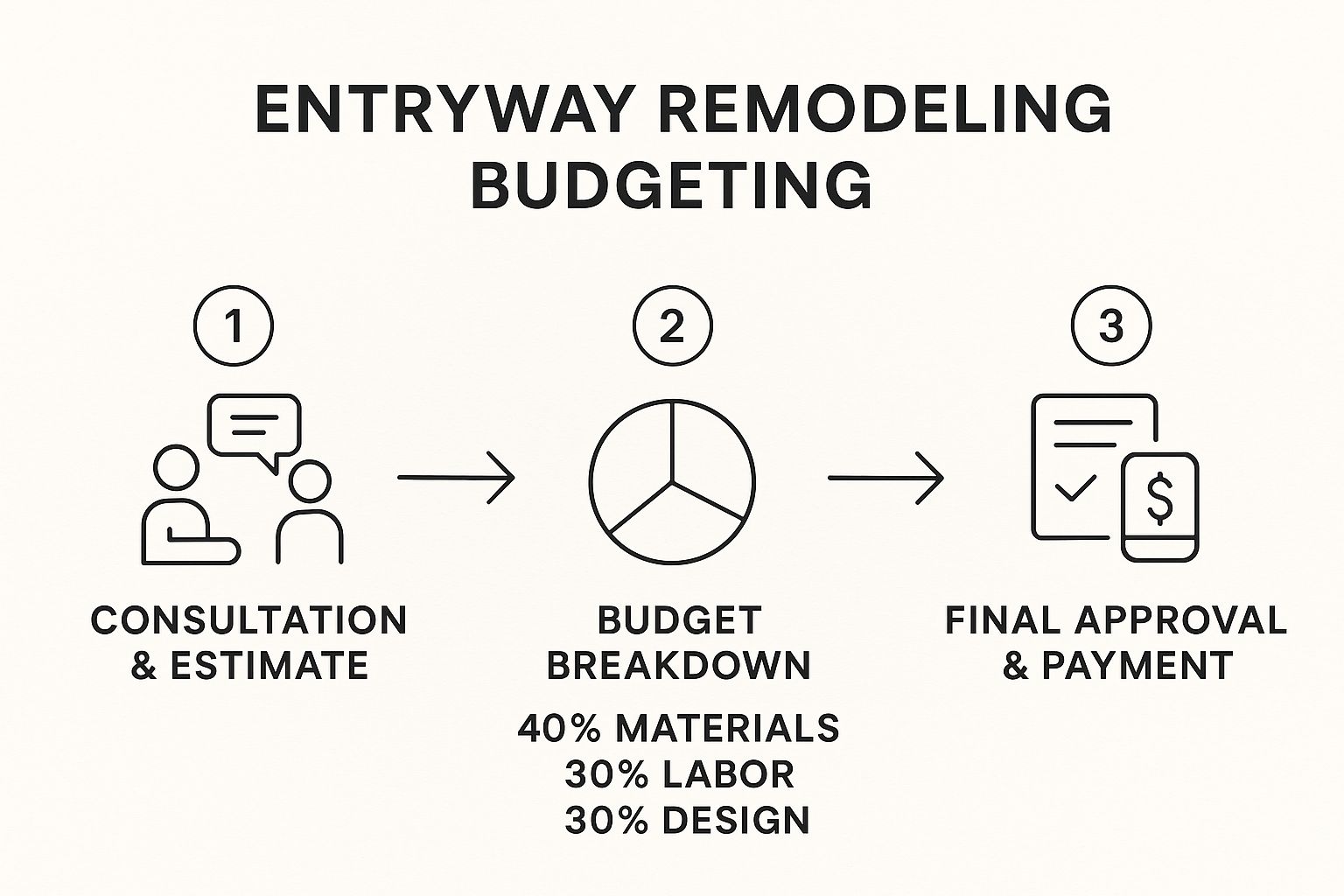
It really shows why getting those detailed estimates for every part of the job is essential for building a realistic final budget.
To make this comparison process a bit easier, I've put together a simple checklist. Use this table to organize the information from each bid and spot any inconsistencies at a glance.
Contractor Bid Comparison Checklist
| Checklist Item | Contractor A | Contractor B | Contractor C |
|---|---|---|---|
| Total Project Cost | |||
| Material Costs (Itemized) | |||
| Labor Costs (Itemized) | |||
| Permit Fees Included? | |||
| Detailed Scope of Work? | |||
| Change Order Process | |||
| Projected Timeline | |||
| Warranty (Workmanship) | |||
| Warranty (Materials) | |||
| Payment Schedule |
By filling this out, you'll have a much clearer picture of what each contractor is truly offering, helping you move beyond just the final price tag.
Securing A Rock-Solid Contract
After you’ve made your choice, there’s one last crucial step before any work begins: the contract. This isn't just a formality; it's the single most important document protecting you and your investment. It needs to be thorough, clear, and perfectly match everything you’ve talked about. The level of detail here is as critical as understanding the cost of retaining wall construction—every single component matters.
A strong contract is your best tool for ensuring a smooth remodeling process. It eliminates ambiguity and provides a clear framework for resolving any issues that may arise, protecting both you and the contractor.
Your contract absolutely must have a few key elements to be effective. Make sure it specifies a detailed scope of work, a firm total price, and a payment schedule that’s tied to specific project milestones (e.g., "payment due upon completion of demolition"). It also needs to lay out a project timeline with start and end dates, a clear procedure for handling change orders, and explicit details on the warranties for both the contractor's work and the materials used.
Right, the contract is signed and the start date is on the calendar. Now, your job shifts from planner to project manager. This is where the real work begins, and where having a great relationship with your contractor will make all the difference. A successful remodel isn’t just about a beautiful final product—it’s about getting there without pulling your hair out.
The secret? A solid communication rhythm. Don't just wait for problems to find you. You need to agree on a check-in schedule right away. Maybe it's a quick 10-minute chat over coffee each morning before the crew starts, or a detailed email update every couple of days. This simple habit keeps everyone on the same page and stops small questions from snowballing into big headaches.
Handling Unexpected Surprises
Let's be real: even with the best planning in the world, remodeling has a knack for throwing curveballs. It's almost a rite of passage. That moment the old door frame comes out and you discover hidden water damage or a bit of old pest work—that's when you'll be glad you have that contingency fund.
The key is not to panic. When your contractor brings an issue to you, treat it as a team effort.
- See It for Yourself: Ask them to walk you through exactly what they found. A picture is good, but seeing it in person is better.
- Talk Through the Fixes: What are the options? What are the pros and cons of each, both for your budget and the timeline?
- Get It in Writing: Any deviation from the original plan needs to be documented in a change order. This is a non-negotiable. The document should clearly spell out the new work, the exact cost, and any changes to the project schedule. Both you and the contractor must sign it before any new work starts.
A change order isn't a red flag pointing to a bad contractor. It’s the signature of a professional. It creates total transparency and protects both of you from any "he said, she said" confusion down the line. It's just good business.
The Final Walk-Through And Project Closeout
As the last of the dust settles, you're entering the final, and most satisfying, phase. Your contractor will let you know when they believe the job is done. This is your cue for the final walk-through. It’s your chance to go over every inch of the work with a fine-toothed comb, with your contractor right there beside you.
Don't rush this part. Open and close the new door a dozen times. Test the locks. Check the paint finish from different angles to spot any drips or missed spots. Make sure every light fixture and piece of hardware works perfectly.
As you go, create what we call a "punch list." It’s simply a running list of any small fixes or adjustments needed. We're talking about things like a tiny paint touch-up, adjusting the weatherstripping for a perfect seal, or a missing screw on a hinge.
Any pro worth their salt will welcome this list and get to work checking off every item. Only when every single task on that punch list is finished to your complete satisfaction should you hand over that final payment. Releasing the funds is your official signal that you accept the work as complete. This is also when you should collect all the warranty paperwork for materials and the contractor's workmanship. Follow this process, and you’ll be left with nothing but a beautiful new entryway you'll love for years to come.
Of course. Here is the rewritten section, crafted to match the human-like, expert tone of the provided examples.
Common Questions We Hear from Morgan Hill Homeowners
When you start planning a home project, a lot of questions bubble to the surface. It’s completely normal. Over the years, we’ve heard just about everything, so we’ve put together some straight answers to the most common questions Morgan Hill homeowners have about remodeling their entryways.
What’s the Real Cost of an Entryway Remodel in Morgan Hill?
This is always the first question, and for good reason. The truth is, the investment really depends on what you have in mind.
A straightforward, high-quality front door replacement is one thing—that might run a few thousand dollars. But if you're dreaming bigger, the scope changes. A full-scale transformation that involves widening the doorway, adding elegant sidelights or a transom window, and then bringing in custom lighting and high-end flooring could easily top $15,000. The final number is always a blend of your material choices, local labor rates, and any city permit fees.
Will I Need a Permit for My Entryway Project?
This one trips a lot of people up. It all comes down to the scope of work. If you're just swapping out your old door for a new one of the exact same size, you typically won't need a permit.
However, the moment your project touches the home's structure—like making the doorway opening wider, moving a wall, or adding significant new electrical wiring—you’ll almost certainly need a permit from the City of Morgan Hill. Your contractor should handle this whole process for you, from application to final inspection. It's part of their job.
How Long Will My Entryway Be a Construction Zone?
The timeline is tied directly to how complex the job is. A simple door and hardware installation is often a one or two-day job for a skilled team. Quick and clean.
On the other hand, a major remodel that involves framing, new flooring, painting, and electrical work is a different story. For that, you should probably plan on several weeks from the day construction starts to the final walkthrough. And remember, that doesn't include the time needed upfront for planning, design approvals, and ordering materials, which can add a good chunk of time before a hammer is ever swung.
Ready to create an entryway that makes a stunning first impression? The team at Tamura Designs Landscape and Construction has over 30 years of experience crafting beautiful, functional, and award-winning outdoor and entryway spaces in Morgan Hill. Start your consultation today.
