
So, you're wondering how much a rainwater harvesting system costs? The short answer is: it depends. You could pay less than $200 for a simple rain barrel you set up yourself. Or, you could spend over $12,000 for a big system that supplies your whole house.
The final price really comes down to a few key things. These include the size of your tank, how complicated the plumbing is, and if you need the water to be clean enough to drink. Let's break it all down so you can figure out what works for you.
Understanding the True Cost of Rainwater Harvesting
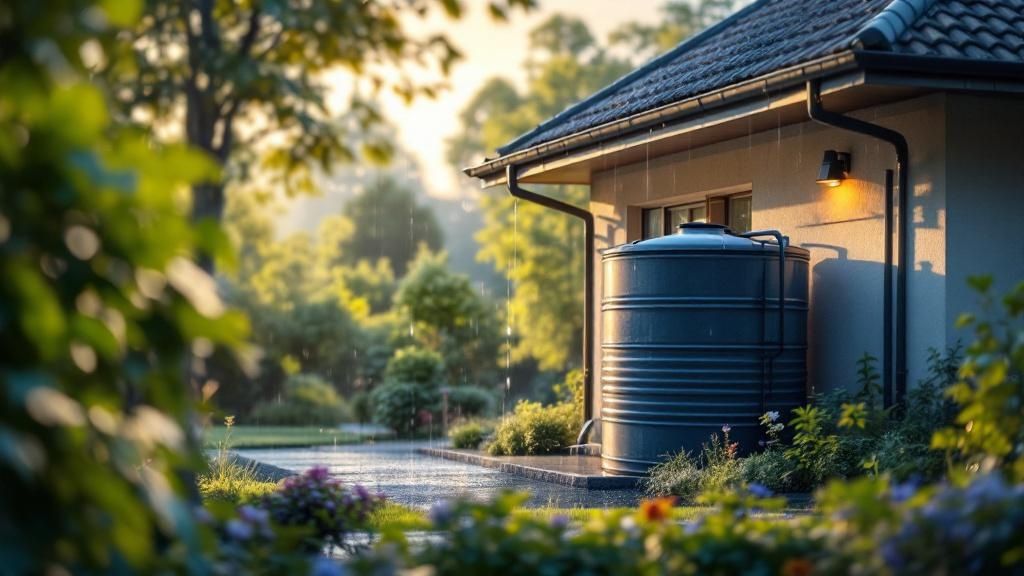
Figuring out the cost of a rainwater harvesting system is a lot like shopping for a new car. You have your basic model that gets you where you need to go. Then you have the fancy version with all the extra features. What you choose is all about what you need and what you're willing to spend.
For some people, a simple rain barrel connected to a downspout is perfect for watering a small garden. But if you want to supply your entire home with filtered water from a large underground tank, you’re looking at a much bigger investment.
Key Factors That Influence Price
The final cost isn't just about the tank. It's a mix of several important parts working together. Understanding these parts will help you see where your money is going and pick the right system for your home.
Here are the main things that will affect your total cost:
- System Size and Capacity: It's pretty simple—a small 50-gallon barrel will cost a lot less than a huge 5,000-gallon underground tank made to supply a whole house.
- Complexity and Features: Every extra part adds to the cost. Things like pumps, special filters, and systems to make water drinkable will raise the price.
- Installation Method: This is a big one. Doing it yourself can save you a lot of money on labor. But hiring a professional will add a lot to your total budget.
The size of your project is the single biggest thing that affects the cost. A basic setup for things like watering your garden is affordable for most homeowners. But a system designed to make you completely independent from city water will cost a lot more.
A Quick Look at Typical Costs
To give you a clearer idea, the cost can vary a lot. Just for home tanks, prices can range from a few hundred to several thousand dollars. This depends on their size and what they're made of.
Above-ground tanks are a popular choice because they're cheaper and easier to install. They often cost between $500 and $5,000. On the other hand, underground systems cost more, sometimes over $10,000. That's because you have to pay for digging and a more complex installation. If you want to learn more, you can look at rainwater harvesting market trends to understand these costs better.
The table below gives you a simple look at what you can expect to pay for different types of systems. Think of it as a starting point for planning your project.
Estimated Cost Ranges for Rainwater Harvesting Systems
This table shows the typical costs for different types of home rainwater harvesting systems, from basic to advanced.
| System Type | Typical Capacity (Gallons) | Estimated Cost Range (Materials & Installation) |
|---|---|---|
| Basic Rain Barrel | 50 – 100 | $150 – $400 |
| Mid-Range Above-Ground System | 500 – 2,500 | $1,500 – $5,000 |
| Large Above-Ground System | 2,500 – 5,000 | $4,000 – $8,000 |
| Whole-House Underground System | 3,000 – 10,000+ | $10,000 – $25,000+ |
As you can see, there’s a solution for almost any budget. The key is to match the system's abilities—and its cost—to what you want to achieve.
Breaking Down Every Cost Component
Ever wonder why your neighbor’s rainwater system only cost $500, while another one down the street cost $5,000? It’s not magic. The final price is the sum of its parts. Just like building with LEGOs, the cost depends on the pieces you choose and how you put them together.
Each part has a job to do and a price. Understanding these separate costs makes the final price less of a mystery. It shows you exactly where your money is going. Let's break it down, piece by piece.
The Foundation: Your Roof and Gutters
The journey for every drop of rainwater starts on your roof. This is your main collection surface, and it’s the most important part of the system. The good news? You probably don’t need to buy a new one. Still, the material your roof is made of can affect water quality. And its size determines how much water you can collect.
From the roof, water travels through your gutters and downspouts. These are like the highways of your harvesting system. Clean gutters are a must to keep leaves and dirt out of your tank. If your gutters are old or leaky, you might need to budget for repairs or replacement. This could add a few hundred dollars to the project.
This diagram gives a great visual of how the different parts affect the total budget.
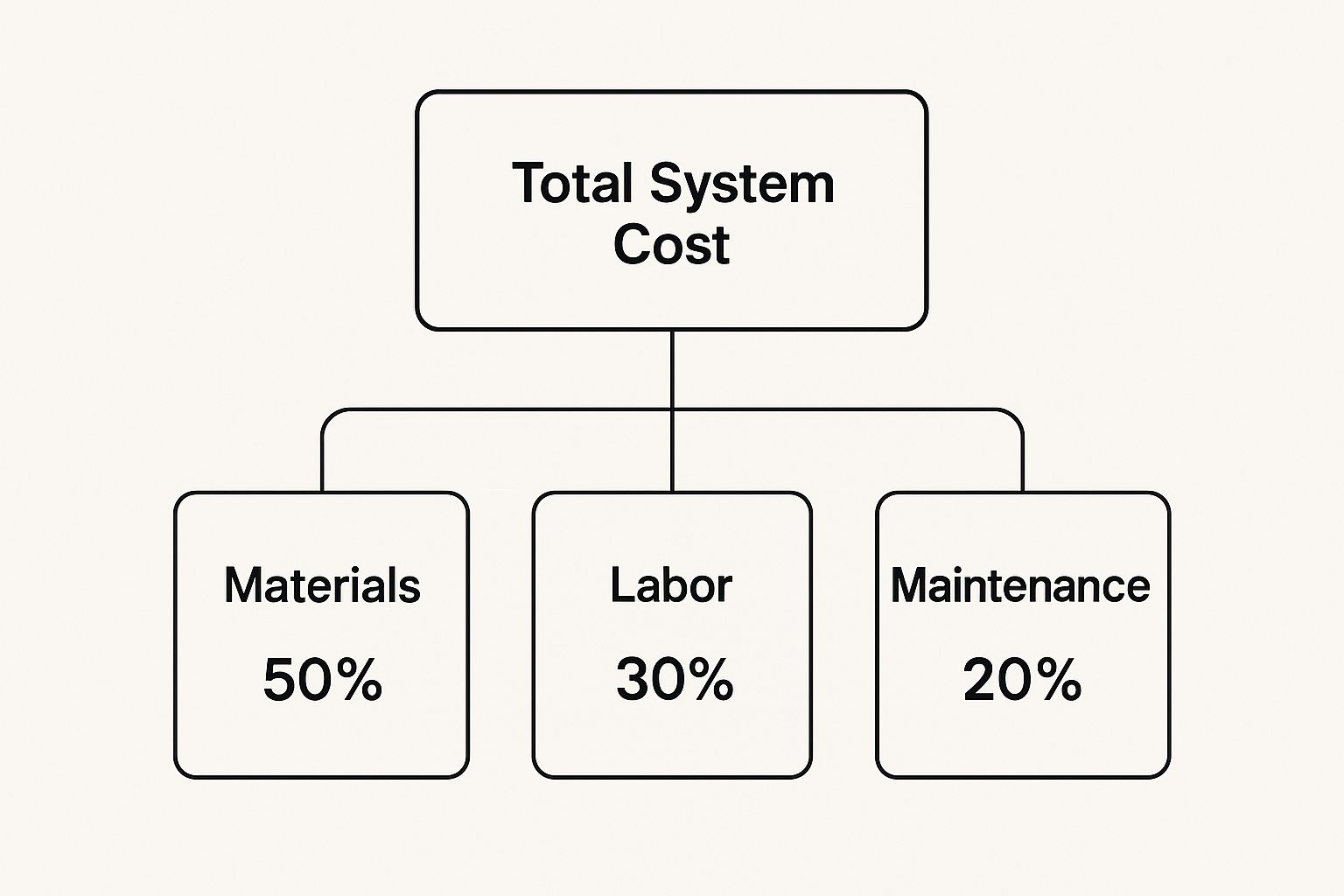
As you can see, materials and labor make up most of the initial cost. That’s why choosing the right parts from the start is so important for keeping your budget under control.
Essential Filters and Guards
Before a single drop of rain reaches your storage tank, it needs to be cleaned. This is where filters and diverters come in. They act as the system’s security guards to keep unwanted things out.
- Leaf Screens and Gutter Guards: Think of these as your first line of defense. They catch the big stuff—like leaves and twigs—before it can clog up your downspouts.
- First-Flush Diverter: This is a very clever device. It acts like a bouncer, sending the first bit of rain away from your tank. That first bit of water is usually the dirtiest, as it washes away bird droppings, dust, and pollen. A good diverter costs between $40 and $150. It makes sure only cleaner water goes into your tank.
A first-flush diverter is one of the best value upgrades you can make. It greatly improves water quality and reduces the amount of dirt that settles in your tank over time.
The Storage Tank: The Biggest Cost Variable
The storage tank is the heart of your system and is almost always the biggest single expense. The cost depends on three key things: its size, the material it’s made from, and where you put it.
Size (Capacity): Tanks can be as small as a 90-gallon rain barrel or as big as a 10,000-gallon tank. As you’d expect, the bigger the tank, the higher the price. A small plastic tank might cost $150, while a large steel one could easily cost over $5,000.
Material:
- Polyethylene (Plastic): This is the most common and cheapest option. It's light, strong, and gets the job done.
- Galvanized Steel: A good mid-range choice known for being strong and lasting a long time.
- Stainless Steel: The best, longest-lasting option. It's very easy to clean but also costs a lot more.
Location (Above-Ground vs. Underground):
- Above-Ground: These are much easier and cheaper to install. That's why they are the top choice for most home projects.
- Underground: This is a great choice if you want to save space and protect the tank from weather. Just be ready for a much more expensive installation, since it involves digging and more complex plumbing.
Distribution: Pumps and Pipes
So, you've collected all this water—now you need a way to use it! This is where the distribution parts come in.
If you want enough pressure for a garden hose, sprinkler, or even indoor plumbing, you'll need a water pump. A good pump will cost anywhere from $150 to over $500, depending on how powerful it is. You'll also need PVC pipes or hoses to connect everything, which can add another $50 to $300 to the final cost.
For larger projects that also need to manage extra rainwater, it's worth learning what permeable pavers are and how they can work well with your system.
Choosing Between DIY and Professional Installation
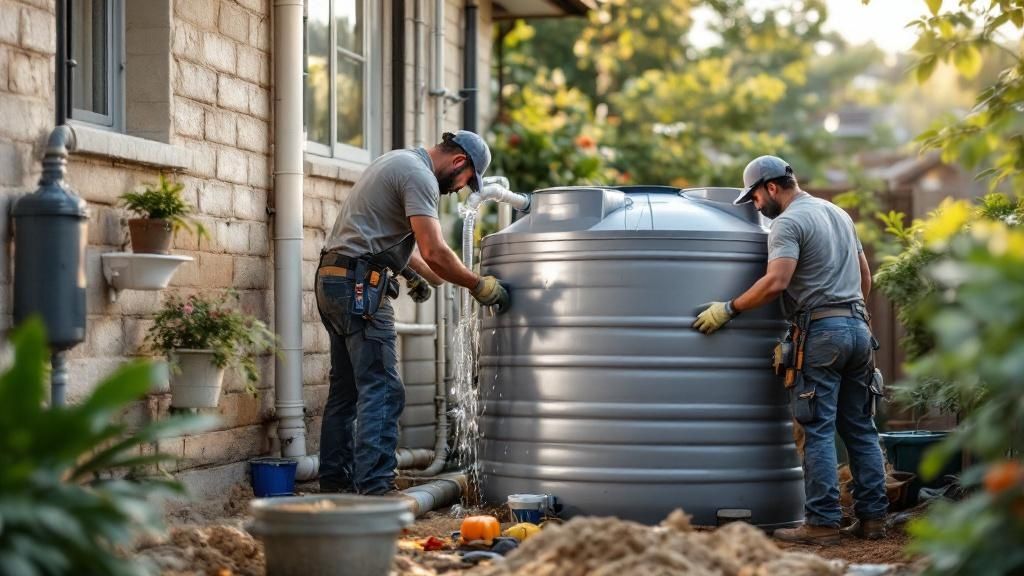
So, you’ve picked out all the parts for your rainwater harvesting system. Now for the big question: who’s going to put it all together? This is where you have two clear choices—doing it yourself (DIY) or hiring a professional.
Both options will have a big impact on your total rainwater harvesting system cost, but in very different ways. The DIY path offers the promise of big savings on labor. Hiring a pro offers experience and peace of mind. Let's look at what each choice really means to help you decide which one is right for you.
The Do-It-Yourself Approach
Going the DIY route is often the cheapest option, especially if you're setting up a smaller, simpler system. If you're comfortable with basic plumbing and assembly, connecting a rain barrel or a small above-ground tank can be an easy weekend project. Many modern tanks and kits are actually designed for you to install them yourself.
But those savings come with a trade-off: you're responsible for everything. You’ll need the right tools, from pipe cutters and glue to a good level. It can be helpful to look at guides for other home projects to get a sense of the work involved. This DIY skylight installation guide gives a good idea of what owner-led projects are like.
The biggest risk with DIY is making a mistake that ends up costing you a lot of money. For example, if you forget to make a perfectly level and strong base for a large tank, it can crack under the heavy weight of the water. A mistake like that could cost you more than you saved on labor.
Hiring A Professional Installer
Calling in a professional will add to your upfront cost, but what you’re really paying for is experience. A pro's fee covers much more than just connecting a few pipes.
Their work usually includes:
- Site Check and Planning: They’ll check your property, find the best spot for the tank, and make sure the setup follows local rules.
- Digging and Foundation: For underground tanks or large above-ground systems, they handle the hard work of digging and pouring a solid concrete base.
- Complex Connections: A pro can connect the system to your home’s plumbing for things like flushing toilets or link it to your sprinklers.
- Electrical Work: If your system needs a pump, you often need a licensed electrician to handle the wiring safely. It’s not something to guess about.
Hiring a professional makes sure the job is done right the first time. This protects your investment and saves you from a lot of future problems.
While the upfront cost is higher, professional installation comes with a warranty on the work. That guarantee gives you peace of mind. If something goes wrong because of the installation, you’re covered.
Comparing DIY vs. Professional Installation
To help you see the choice more clearly, let's put these two options side-by-side. The best path for you really depends on your system's complexity, your own skills, and your budget. Are you looking for upfront savings, or is long-term reliability your main goal?
This table breaks down the key differences to help you weigh the pros and cons.
| Consideration | DIY Installation | Professional Installation |
|---|---|---|
| Upfront Cost | Low (materials only) | High (materials + labor) |
| Required Skill Level | Basic to intermediate | None required |
| Time Commitment | High (several hours to days) | Low (professionals work quickly) |
| Risk of Errors | Moderate to high | Low (covered by warranty) |
| Best For | Simple, small-scale systems | Complex or whole-house systems |
Looking at this comparison should give you a clearer picture of which installation method is best for your project and your comfort level.
Understanding Your Return on Investment (ROI)
So, you're wondering if a rainwater harvesting system is really worth the money. While there's an upfront cost, the real story is about the value you get back over time. This is where we look past the price tag and talk about your Return on Investment (ROI).
Think of ROI as the break-even point. It’s the moment your system has paid for itself through all the money you've saved. Every drop of rain you collect is water you don't have to buy from the city. You can use this free water for many things, from watering your garden to washing your car or even flushing toilets.
How Rainwater Slashes Your Water Bills
The most obvious benefit is using less water from the city. Water bills are not getting any cheaper—in fact, they keep going up.
By using the rain you’ve collected for all your non-drinking water needs, you'll see a real drop in your monthly utility bills. For most homes, outdoor watering uses the most water, especially in the summer. A good-sized rainwater tank can often get rid of that expense completely.
A rainwater harvesting system turns a monthly bill into a one-time purchase. Instead of paying for water forever, you pay once for the system to collect it for free.
This trade-off is only getting better with time. City water prices are rising by an average of 3-5% each year in many areas. This makes collecting your own water a very smart move. Plus, some governments offer programs that can cover 10-30% of the cost, making the initial purchase much easier.
A Realistic Savings Example
Let's use some real numbers. Imagine a family with a $150 per month water bill. In the warmer months, about $60 of that (40%) is just for watering their lawn and garden.
- System Cost: They choose a mid-range above-ground system and have it installed for $4,000.
- Annual Savings: By using rainwater for all their outdoor watering, they save $60 a month for six months of the year. That’s a total of $360 saved each year.
- Payback Period: Now for the ROI. We just divide the total cost by the yearly savings: $4,000 / $360 = about 11 years.
After just over a decade, the system has paid for itself. From that day on, every gallon it collects is pure savings, year after year.
Beyond the Water Bill
But the money benefits don't stop with your utility bill. A professionally installed rainwater harvesting system is a feature that adds real value to your property. It's a huge plus for potential buyers who care about saving resources, especially in areas that often have droughts.
It also gives you great water security. When the city limits watering or has a shortage, you'll have your own private supply to keep your yard green and healthy. A well-planned system can be a key part of a smart property plan, which you can learn more about in our guide on backyard drainage solutions.
Factoring in Lifetime Maintenance Costs
Of course, no system runs forever without a little care. To get the full picture of your investment, you need to budget for some small, ongoing maintenance.
The good news is that these costs are usually pretty low:
- Filter Replacements: Depending on your setup, you'll likely need to change filters once a year. This is usually a $20 to $100 expense.
- Gutter Cleaning: Keeping your gutters free of leaves and dirt is important for good water quality, but it's something most homeowners already do.
- Pump Servicing: If your system has a pump, it might need a check-up every now and then. A quality pump, however, can run for years without any trouble.
When you compare these small yearly costs to the hundreds you'll save on your water bill, it becomes clear that rainwater harvesting is a good long-term choice.
Finding Rebates to Lower Your Initial Cost
What if you could get a little help paying for your new system? A lot of homeowners don't know there are often programs that can make the initial rainwater harvesting system cost much lower. It’s like getting a coupon for a major purchase—it just makes the decision that much easier.
These programs exist because cities and states want to encourage people to save water. By offering rebates, tax credits, and grants, they make it more affordable for you to buy a smart, helpful solution. Taking a little time to look for these opportunities can seriously lower your upfront costs.
Where to Look for Financial Incentives
Finding these programs is often much easier than you’d think. Your local water company is the best place to start. A quick search on their website for "rainwater harvesting rebate" or "water conservation program" will usually point you in the right direction.
You can also find support at different levels of government:
- City or County Programs: These are the most common. Many local governments offer simple rebates for buying rain barrels or larger tanks.
- State-Level Incentives: Some states offer tax credits, which directly lower the amount of state income tax you owe.
- Federal Tax Credits: While less common for rainwater systems, it’s always worth checking for federal programs related to saving energy and water.
Don't just assume these programs don't exist where you live. Many are not used much simply because people don't know about them. A few minutes of research can lead to hundreds, or even thousands, of dollars in savings.
How These Programs Are Evolving
As more people care about green building and sustainable living, these programs are becoming more popular. Governments around the world are using them to encourage homeowners to start harvesting rainwater. This trend is also growing in the business world, where these systems are becoming a key feature for green buildings.
Besides looking for direct rebates, it’s also smart to explore other financial ideas. For example, understanding equipment leasing tax benefits can show you different ways to make a system more affordable. These financial tools can be just as helpful as a direct payment.
Applying for these programs usually just means filling out a form and sending in receipts for what you bought. Just make sure to read the rules carefully before you buy anything. Some rebates have specific rules about what you can buy or who can install it. With a little planning, you can make this smart investment much easier on your budget.
Why Rainwater Harvesting Is a Growing Trend
Let's be honest, installing a rainwater harvesting system is about more than just saving money on your water bill. It’s a choice to join a bigger conversation about how we use water. Around the world, growing cities, changing weather, and a real desire to live more sustainably are making this practice more common.
When you think about it, investing in a system for your own home is a really practical step. It’s not just a personal upgrade; you’re building a stronger and more independent future for your property. Plus, you’re helping reduce the strain on local storm drains and getting a reliable water source for your garden during dry summer months.
A Market Driven by Innovation
This rise in popularity is great news for homeowners because it’s leading to better technology. As more people want these systems, companies have to create new and better products. This means the systems on the market today are more efficient, stronger, and easier to use than ever before.
The numbers prove this.
Market research shows the rainwater harvesting industry was worth about USD 1,609 million in 2024 and is expected to grow to USD 2,314 million by 2033. This growth is driven by people caring more about the environment and a wave of new tech, like advanced filters and smart monitoring systems. You can see the numbers for yourself with these market statistics on IMARC Group.
What this really means is that the rainwater harvesting system cost today gets you much better technology than it did a few years ago. You’re not just buying a tank; you’re investing in a modern solution from an industry that’s always improving.
Integrating Sustainability into Your Landscape
A rainwater harvesting system isn't just a piece of equipment; it's a key part of a bigger plan for your property. Think of it as a tool that supports a greener, more self-sufficient outdoor space. When it's designed well, it fits in with other eco-friendly features to create a yard that’s both beautiful and responsible.
For anyone who wants to fully embrace this idea, the system can become the foundation of a complete outdoor plan. To see how these systems fit into the bigger picture, check out our guide on sustainable landscape design. It’s full of ideas for creating useful, beautiful, and environmentally friendly outdoor areas. Your system stops being just a utility and becomes a central part of a forward-thinking home.
Common Questions About System Costs
Even after breaking down the numbers, you probably still have a few questions. That's completely normal. Let's answer some of the most common ones we hear to clear up any confusion and help you move forward.
How Much Does a Simple Rain Barrel Setup Cost?
Getting started with a basic rain barrel is the most affordable way to try rainwater collection. You can find a ready-made barrel for somewhere between $100 and $300. These are great options that you can hook up and start collecting water with in under an hour.
If you're handy and enjoy a good weekend project, you can build your own for as little as $50 to $100. All it takes is a food-safe barrel and a quick trip to the hardware store for the right parts. It’s a perfect, low-risk way to start watering your garden with rainwater and see how it works for you.
Are Underground Tanks More Expensive to Install?
Yes, and it's a pretty big jump in cost. The tank itself might not be that much more expensive than an above-ground one, but the installation is completely different. It’s a much bigger job that makes the price go way up.
You're not just paying for a tank; you're paying for a small construction project. Think about it—you'll need to cover:
- Excavation: This means bringing in a small digger to make a huge hole, which costs a lot in labor.
- Specialized Labor: Getting a huge tank safely into the ground requires the right equipment and people who know what they're doing.
- Complex Plumbing: All the plumbing lines have to be buried and carefully connected from your home to the tank.
All together, a professionally installed underground system will likely start at around $10,000, making it a serious investment.
What Are the Typical Ongoing Maintenance Costs?
Here's some good news: the ongoing maintenance for a rainwater harvesting system is usually quite low. But don't think "low cost" means "not important." A few simple tasks are key to keeping your system running well and your water clean. Your main jobs will be cleaning your gutters twice a year and checking your filters.
The most common regular expense you’ll have is replacing your system's filters. Depending on the type you have, this could cost you anywhere from $20 to $100 a year. It’s a small price to pay for great water quality.
Every few years, it's also a good idea to look inside the tank and check for any dirt buildup. If your system has a pump, it might need a little service now and then, but these are small costs that are easily covered by your water bill savings.
Do Government Rebates Really Cover Much of the Cost?
They absolutely can! Many local water departments and city governments offer great rebate programs to encourage people to save water. These can often cover a good part of your material or installation costs.
The best way to find them is with a quick online search for "rainwater harvesting rebate" along with your city or county name. Here's an important tip: always check the program rules before you buy anything. Some rebates have very specific rules for equipment or installation, and you'll want to make sure you qualify.
Ready to explore how a custom rainwater harvesting system can enhance your property and support a sustainable lifestyle? The team at Tamura Designs has over 30 years of experience creating beautiful and functional outdoor spaces. Learn more about our award-winning landscape design and construction services at https://tamuradesigns.com.
